

From its early days as a humble mining game on WAX, Alien Worlds has transformed into a community-driven decentralized metaverse where players compete, collaborate, build, write, vote, and determine the direction of travel for an ever-expanding transmedia franchize.
At the heart of this creative wellspring is Tokenized Lore, a novel framework that has succeeded in building out the original sci-fi backstory into an intricate canon capable of supporting everything from short stories and NFT collections to comics and games.
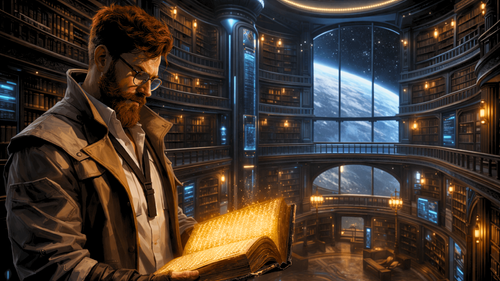
Many people were key to the vision of Tokenized Lore, among them Dacoco’s Chief Marketing Officer Kevin Rose, who worked directly with master storyteller Kevin J. Anderson. Another of the central players was ‘Lore Librarian’ Lalothen, whose unique role combines a forensic knowledge of the existing mythology with a curator’s eye for fresh ideas and perspectives.
We recently spoke to Lalothen about the journey from formative lore to a thriving narrative ecosystem, the challenges of maintaining consistency at scale, and what the future might look like for the Alien Worlds Metaverse.
Meet Lalothen
If you’re new to these parts, this might be the first time you’re reading about Lalothen. But even if you’re an OG, you mightn’t know exactly who he is. So… who is he? And how did he end up becoming a vital member of the Alien Worlds community?
“I’ve been a massive gamer and sci-fi fan for decades, and it was actually during Covid that I came across Alien Worlds,” he reveals. “I’d started to dabble a bit in crypto, and was interested in the concept of blockchain gaming. By chance, I came across an ad for the WAX blockchain, had a look around, spent some time playing a game called Prospectors, then finally looked into Alien Worlds after listening to Dacoco’s CEO Saro speak during a webinar.
“At the time, she made a very good case for the concept of decentralized gaming, individual ownership of game assets in the form of NFTs, and so on, so I decided to give it a try. The rest, as they say, is history.”
Rebuilding the Foundations
Lalothen’s involvement in Alien Worlds led to the Tokenized Lore initiative, the first step of which was revamping the base mythology. “The original lore was more ‘bare bones’ and quite tongue-in-cheek,” Lalothen explains. “We wanted something more comprehensive that could translate into a robust framework for engaging storytelling.”
Alien Worlds Lore 2.0 fleshed out the origins of Trilium and Triactor Technology and created distinct alien races with their own tech, architecture, and cultures. And who better to write it than best-selling sci-fi author Kevin J. Anderson, whose credits include spin-off novels for Star Wars, Dune, and The X-Files?
After Anderson added his stardust, Lalothen helped develop his ideas into the official Tokenized Lore book: a written and visual compendium that serves as the terra firma of the Alien Worlds Metaverse.
“I had the pleasure of creative talks with Kevin on a couple of occasions. One of my favourite races – the Lopati – was his creation, and taking his concept and adding elements like architecture and technology was incredibly satisfying.
“When the first draft of the lore book was complete, it felt surreal. If you had asked me five years ago whether I thought I’d be collaborating on such a creative endeavour, with the involvement of a legendary author no less, I’d have laughed.”
Adapting the Lore Treatment
What did the process of turning Anderson’s treatment into a definitive lore guide look like?
“Several of us worked on creating consistent imagery in different visual styles,” Lalothen recalls. Generative AI played a key role, producing concept art that the Lore Squad (a team of creative staff members) reviewed and refined.
Perhaps inevitably, a dedicated Lore DAO tasked with managing player contributions emerged. “The DAO allows members of the community to submit written content designed to expand the existing canon,” Lalothen says. Submissions are voted on by the community, and only those that pass the required threshold are canonized.
“I found the whole process very exciting, as it gave us an opportunity to create unique alien races, build a solid rationale regarding the ubiquitous nature of Trilium, and transform the lore into something that could be used as a spring board for creating new content: stories, comics, videogames, etc,” says Lalothen.
From Librarian to Curator
Lalothen’s role as Lore Librarian grew organically from his early work on the framework. “I effectively carry that framework in my head now,” he says, “making it easy for me to review new content and determine how well it adheres to the existing canon, whether the way it expands the lore makes sense.”
Much of his time is now spent collaborating with creators, working closely with Galactic Hubs grantees to ensure their projects stay true to Alien Worlds. Lalothen also oversees the GHubs Lore Grant, which incentivizes high-quality writing that meaningfully expands the universe.
“A lot of my Librarian time is spent working with individuals or teams seeking to utilize or expand the lore. A good writer needs several things: a strong imagination, at least a decent grasp of the existing canon, and a willingness to accept and act upon feedback,” Lalothen explains.
When the program opened in mid-2024, many early submissions were rough, requiring extensive notes from Lalothen and his ‘Lore Scribe’, RED. Over time, writers improved dramatically, with Ender singled out as someone who “took his writing seriously and went the extra mile to show tangible improvement with every submission.”
Of the recurring pitfalls he sees, over-reliance on generative AI ranks high. “AI is a great tool for brainstorming a good plot and characters but the actual story output needs to be read through and often quite heavily edited, particularly for a longer story as Gen AI often introduces inconsistencies over time.”
Unsurprisingly, Lalothen views AI as an assistive tool rather than a replacement for human imagination and critical thought.
A Decentralized Alternative to Traditional Lore
Tokenized Lore sets Alien Worlds apart from both traditional gaming IPs and many other web3 projects. Unlike the Star Wars Extended Universe, which expanded from a central canon, or Disney’s later consolidation, Alien Worlds hands creative responsibility to the community.
“We’ve created the basic framework; now it’s up to the people to flesh that out democratically, and in a meaningful way,” Lalothen says. There is no opaque central authority deciding canonicity; players decide.
“Because creative responsibility is in the hands of the community, there won’t be a situation like when Disney took over the Star Wars IP: vast swathes of community-created lore spanning decades – considered canon by the community and in some cases by Lucasfilm – were suddenly faced with the prospect of being delegitimized.”
What’s Next?
Lalothen expresses excitement about a number of upcoming projects, including Alien Legends and New Genesis, both of which are being built around the established canon in story and visuals.
“My hope is that the community continues to expand the canon through the Lore DAO,” he says, while acknowledging the technical hurdles that make the current system challenging to use. Encouragingly, the team is working on a fresh initiative to further gamify the revamped lore, though details remain under wraps for now.
For aspiring contributors, his advice is straightforward: “Make sure your writing meshes well with the existing canon, expands it in some way – no matter if it’s just a very small way – and above all, that it makes for compelling reading. Don’t be shy about asking for help or critique, either from me or other community members willing to read and offer feedback.”
Alien Worlds is no longer just a game, it’s a universe shaped by its players. With Lalothen and the Lore DAO guiding the narrative, the canon will continue to grow in ways that are as unpredictable as they are exciting. Whether you’re a miner, a writer, or simply a fan of science fiction, the invitation is open: come build something, tell a story, and help decide what happens next.