

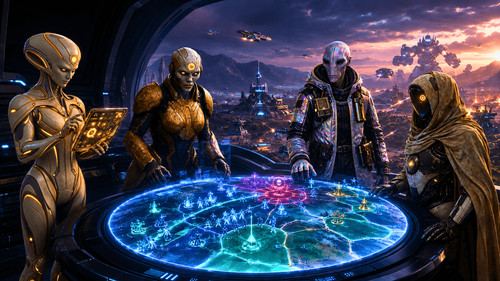
Over the last three years, Planetary Defense has grown into one of the most popular community-led strategy games in the Alien Worlds Metaverse.
With the project’s developers recently celebrating the launch of its Beta V3, we sat down with them to discuss its origins, ambitions, and challenges.
The Idea That Sparked Planetary Defense
“The original idea was actually pretty simple: we wanted to make Alien Worlds feel more alive,” says prominent community member MjaM, who has served as a Custodian of multiple Syndicates. “At the time, there were a lot of Alien Worlds NFTs that we felt had more potential than the utility they were getting.
“We wanted Lands to feel like actual territories, to create a real sense of belonging. It could have troops, commanders, defenses, and players fighting together under the same banner. And importantly, you didn’t necessarily need to own Land to participate; players could choose a flag, join a side, and contribute to something bigger than their individual account.
That was really the original spark behind Planetary Defense. Take the existing Alien Worlds universe and give players more reasons to live inside it. We probably didn’t realize just how far that idea would take us.
That’s an understatement: for several months, Planetary Defense has been among the most active projects by volume in the WAX ecosystem. “For something that started as a relatively small project, that’s pretty satisfying,” notes MjaM.
A Gateway to Web3 Gaming
Planetary Defense can be described as a free gateway into Web3 gaming, one designed in such a way that even complete newbies can plug in and play through Discord.
“You don’t need to understand wallets, blockchains, marketplaces, staking and seventeen other Web3 words before you’re allowed to have fun,” explains MjaM. “You can simply start playing, completing missions, fighting bosses, trading, collecting NFTs and progressively building your account.
“Then, as you get more comfortable, there’s a natural transition toward the Web3 side; things you earn start to have a bigger purpose. You can use them in missions, PvP and Land Defense, with many more connections between the Discord game and V3 planned over time.”
Although Magor was the nerve center of the Planetary Defense brain trust, and where the game really started to take flight, today its team are involved in various capacities across all six Alien Worlds planets. As the builders have fanned out, so too has the game expanded in scope.
“The first versions of Planetary Defense were more focused on Land Defense and built almost entirely around Alien Worlds NFTs,” says MjaM.
“But as the game grew, so did everything happening behind the scenes. Development, servers, rewards, tools, security. We needed infrastructure that could handle growth, systems to reduce bot abuse, and people capable of reacting when something inevitably broke. Maintaining a Web3 game takes a little more than enthusiasm and a Discord server!”
Constant Evolution
While V2 broadened the gameplay considerably by bringing many new mechanics into the ecosystem, the arrival of Beta V3 this past July represents one of the project’s biggest upgrades. Within a month of its launch, the game saw 2.4M Trilium (TLM) distributed and over 160,000 on-chain transactions, with 2.6M WAX in secondary NFT sales.
“V3 is only half of the picture,” MjaM explains. “The Planetary Defense Discord game has also been expanding quickly, with missions, bosses and plenty of new mechanics. Discord and V3 are closely connected, with both working together as part of the same experience. One feeds the other, that’s the beauty.
“You can start on Discord, earn assets and discover the ecosystem, then progressively move into the Web3 game. What happens there also gives you more reasons to come back to Discord.”
Among recent developments that were hailed by the community was a Mission Alert Bot that simplifies the playing experience. As MjaM notes, “Planetary Defense has players in different countries and time zones. Nobody should have to stare at Discord all day just in case something interesting happens.”
As for the Toolkit, it reflects the fact that players have more NFTs, statistics, missions, resources, and decisions to make than ever before.
“Good tools take all of that info and make it easier to use. And we also have to credit the community: we’ve had players create their own tools, statistics and add-ons, which we absolutely encourage. When people start spending their own time building things around your game, that’s a pretty strong sign you’ve created something they really care about.”
Why Teamwork is Central to Planetary Defense
While many Web3 games are pitched at solo players, collaboration is key in Planetary Defense and MjaM expects this aspect to become even more noticeable as V3 expands.
“Land Defense is one example, where you often need support from other players, but the bosses in the Planetary Defense Discord game are probably the clearest example. When one appears, you’ll regularly see players immediately start coordinating: Which one are we attacking? Where are we sending our damage? Who’s focusing on what? And, of course... Why the hell did you attack THAT one?!
“You can have strong NFTs and a powerful account, but a coordinated group of players can accomplish things that one player can’t. Which is an idea that has quietly been part of Planetary Defense since the beginning: collective effort should reward players more than simply playing alone. “As V3 expands into Lands, community missions, PvP, and larger strategic systems, choosing who you fight alongside and how effectively you work together should become increasingly important.”
What’s Next?
So, what does the future hold for Planetary Defense?
“The core team has a clear vision and a pretty precise idea of where we want the game to go. Our objective is to make it resilient enough that it doesn’t need perfect market conditions to keep moving forward,” says MjaM.
We want to demonstrate to Alien Worlds, particularly GHubs and the planetary DAOs, and more broadly to the WAX ecosystem, what Planetary Defense can contribute. We don’t simply want to receive resources, but rather show that those resources can create activity, NFT utility, player retention, new users, and value that flows back into the broader ecosystem. That’s something we’ve been trying to prove through actions, not just promises, for nearly three years.
With an ambition to bring Alien Worlds NFTs deeper into Planetary Defense, and a pledge to continue working with the community to refine the game, MjaM and co. don’t look like slowing down anytime soon. Which is something its loyal army of players will be celebrating.
Speaking of which, he has a message for them. “A huge thank you goes to our community for helping us build this. Every player who completed a mission, fought a boss, tested a feature, reported bugs, suggested ideas, argued with us over game balance or simply spent time hanging out in Discord has contributed in some way to what this project has become.
“I’d also personally like to thank the Planetary Defense team. Over the years, we’ve built relationships that go far beyond simply working on the same game. Everyone has become a key part of the machine, and that’s probably one of our greatest strengths today.”