

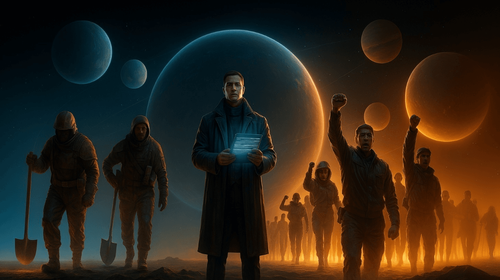
If you’re reading this, chances are you’ve mined Trilium on Neri, Naron, Magor, Eyeke, Kavian or Veles (or maybe all six). Of course, mining probably describes just part of your participation in Alien Worlds. Power users in these parts stake, vote, govern, build, compete, and regularly expand the game’s mythology by contributing to the Lore DAO. In a way, the term ‘gamer’ doesn’t seem adequate to describe an Alien Worlds Explorer.
Launched five years ago, Alien Worlds started life as a multi-chain play-to-earn (P2E) game, dispensing free shovel and avatar NFTs to those keen to mine the native token. While this model proved an instant hit, hooking over 100,000 players within five months, a continued focus on P2E would have been a mistake. Thankfully, the playing community ignored the ceaseless play-to-earn hype and, through their continued interactions with its smart contracts, made it the world’s most-played on-chain game.
This shift didn’t happen overnight; it’s been a steady climb fueled by organic growth, thoughtful grant deployment, technical refinements, and Dacoco’s bold vision. As the five-year anniversary of Alien Worlds approaches, let’s take a look at how it evolved beyond its play-to-earn origins and reflect on the direction of travel.
From Payouts to Power
Half a decade ago, Alien Worlds was essentially a clicker – a very good clicker but a clicker nonetheless. It was fun, free-to-play, and an intriguing proving ground for Web3 gaming at a time when the sector was finding its feet. As the player count rose, work continued in the background to develop and refine the Planetary Syndicate DAOs that would forever change the course of the project.
With the arrival of Syndicates in 2022, governance responsibilities for each planet were handed, in large part, to players themselves. While the core mining game remained, those who wished to exert a greater influence were now able to stake Trilium to gain vote power and run for Custodianship of a planet, with weekly elections determining the victors.
DAOs had been a familiar means of governance in the wider crypto world, with the first established seven years earlier on Ethereum. But the idea of giving players a say in how a game was developed and operated via token-based voting was still novel in 2022. Uptake was high, and soon Explorers were managing TLM budgets, funding tournaments and events, building tools, and shaping infrastructure.
Fast-forward to today and the Alien World ecosystem boasts no less than 13 DAOs, comprising six Planetary Syndicates, six Union DAOs geared towards larger-scale projects, and a Lore DAO dedicated to managing the game’s sci-fi mythology.
By handing players a measure of autonomy, and committing to greater levels of decentralization over time, Alien Worlds has prevented itself from falling into the P2E trap. Which is just as well, since earning-obsessed gamers often ghost once the hype fades.
Although a 2023 BlockWorks op-ed proclaiming “the death of play-to-earn gaming” overstated the case, the truth is this: the prospect of earning will only inspire loyalty in gamers for as long as they’re earning more than they could by playing another game. And no-one game can make that promise.
Gameplay > Profits
Of course, only some Explorers actually show an interest in becoming Custodians or participating in voting generally. The important thing is that they can do so, if they wish. Away from governance, one of the keys to Alien Worlds’ growth has been a focus on gameplay over profit. Play-to-enjoy, if you will.
The mining game remains central to that, as miners love assembling and refining their rigs to get the most juice from the squeeze; since 2020, new tool NFTs have appeared and a shining/forging system also introduced, enabling strategists to upgrade their tools from stone to gold, then stardust, then antimatter. That’s in addition to six categories of rarity, from abundant all the up to mythical.
If your progress is such that you end up with three mythical-tier tools, shined to perfection, you’ll pocket plenty of Trilium and NFT points; at this stage, you might consider becoming a land-owner to earn a percentage of Trilium mined upon there. Otherwise, you can put your top-tier NFTs to work in multiple spinoff games like Meta Battler, a deck-building rogue-like game that bridges the worlds of collectibles and play-to-earn.
Galactic Hubs is Fueling Community Creativity
The same year Syndicates launched, community-driven growth was given a shot in the arm through Galactic Hubs, a grant program created to support projects building on Alien Worlds’ firm foundations. Since its debut, GHubs has mentored countless builders and helped bring many great ideas to life; without it, projects like Milky Way Miner, Battlefleet Armageddon, and Meta Battler wouldn’t have made the same mark. One of the great things about Galactic Hubs is that anyone can apply for funding, from individual comic book artists to small web3 gaming studios. The common denominator of grant recipients is that they can infuse something new and exciting into the metaverse. In essence, Galactic Hubs ensures Alien Worlds stays fresh and dynamic, giving players reasons to stay beyond earning in-game rewards and governing.
The Next Five Years, and Beyond
Alien Worlds’ evolution from a simple P2E game to a sprawling metaverse shows what happens when a community takes the reins. Players aren’t here to earn a living; they’re here to have fun, chase glory, and make connections. With over 410,000 active wallets engaging with Alien Worlds in the last 30 days, the community is heavily invested in the ecosystem and its future.
And what does that future look like? In the absence of a crystal ball, we cannot say for certain: but with decentralization in the game’s DNA, the DAOs will play a critical role. So, too, will game developers be capable of integrating Alien Worlds lore and NFTs, and striking a chord with the player base.
In summary, there’s never been a better time to jump into the metaverse and make your mark, whether your forte is building, animating, writing, gaming or governance. Alien Worlds is a broad church and everyone is welcome to plug in and find out what all the fuss is about. The question is, have you got what it takes to create a legacy?
Developers can access our API toolkit here, and if you’re interested in seeking a Galactic Hubs grant, well, what’s stopping you? Dive into the Planetary Syndicates or Union DAOs and start flexing your governance muscles. If you need any assistance, don’t hesitate to reach out via our official Discord or Telegram channels.